
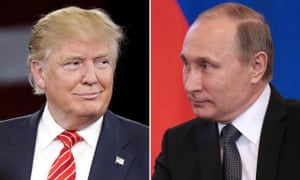
A key figure at the Republican national convention where Donald Trump was nominated for president has strong business ties with Ukraine.
The party platform written at the convention in Cleveland last week removed references to arming Ukraine in its fight with Russia, which has supported separatists in eastern Ukraine. Trump’s links to Russia are under scrutiny after a hack of Democratic national committee emails, allegedly by Russian agents.
Frank Mermoud also has longstanding ties to Trump’s campaign chairman, Paul Manafort, who in 2010 helped pro-Russia Viktor Yanukovych refashion his image and win a presidential election in Ukraine. Manafort was brought in earlier this year to oversee the convention operations and its staffing.
Three sources at the convention also revealed that they saw Phil Griffin, a longtime aide to Manafort in Kiev, working with the foreign dignitaries programme. “After years of working in the Ukraine for Paul and others, it was surprising to run into Phil working at the convention,” one said.
The change to the platform on arming Ukraine was condemned even by some Republicans. Senator Rob Portman described it as “deeply troubling”. Veteran party operative and lobbyist Charlie Black said the “new position in the platform doesn’t have much support from Republicans”, adding that the change “was unusual”.
Thousands of Democratic National Committee emails were hacked and published by WikiLeaks on the eve of the party’s convention in Philadelphia this week. They showed that officials, who are meant to remain impartial, favoured Hillary Clinton and discussed ways to undermine her rival, Bernie Sanders. The leak led to the resignation of chairwoman Debbie Wasserman Schultz.
The FBI is investigating, with all signs pointing to Russian involvement, though Moscow rejects this. Experts note Vladimir Putin’s past attempts to damage western democracy, including cyber-attacks on French, Greek, Italian and Latvian elections. In 2014, malware was discovered in Ukrainian election software that would have robbed it of legitimacy.
Alina Polyakova, deputy director of the Dinu Patriciu Eurasia Center at the Atlantic Council, said: “We can’t say 100% that Mr Putin had a hand in any of this but this kind of meddling in other countries’ affairs is part of Russia’s toolkit. It’s a kind of asymmetric warfare. To me, this looks like something straight from the Russian secret service playbook, but I’m surprised at how brazen they’ve been.”
James Rubin, a former assistant secretary of state now advising the Clinton campaign, said: “If you are the president of Russia and you have stated over and over again that you are concerned that the United States – through its enlargement of Nato, through its policies in Europe towards Ukraine, towards Georgia, towards other countries in Central Asia – are putting pressure on Russia, and you are the president of a country that has been seeking to undermine that process and roll back the independent Europe that’s whole and free and push it back, that’s your foreign policy objective.
“So then you look at the United States and you say, well, which party’s policies would be more likely to allow me to achieve my objectives? That’s the way that a Russian leader would think.”
With Democrats and journalists now trawling through Trump’s past dealings with “all the oligarchs”, as he once put it, as far back as Russia’s Soviet days, the candidate repeatedly, and angrily, this week stated that he has “zero, nothing to do with Russia”. But he continued to refuse to release his tax returns, which could prove his claim definitively.
Past courtships
If he doesn’t have anything to do with Russia today, he certainly has in the past. Trump has attempted to build namesake branded hotels and condos in Moscow as far back as 1987 – when it was still the Soviet Union. “It’s a totally interesting place,” he said at the time. “I think the Soviet Union is really making an effort to cooperate in the sense of dealing openly with other nations and in opening up the country.”His desire to build a Trump Tower near Red Square continued throughout the 1990s, and in 2013 the billionaire businessman travelled to Moscow to meet Putin hoping to discuss the plan while taking in the Russian debut of Trump’s Miss Universe beauty pageant.
Putin cancelled at the last minute, according to the Washington Post, but sent a gift and personal note. While Trump didn’t get to meet Putin on the trip, he did collect a reported $14m from Aras Agalarov, a Azerbaijani-Russian billionaire property developer and close Putin associate, and other business figures for bringing Miss Universe to Agalarov’s 7,500-seat Crocus City Hall.
Trump was photographed with personalities such as the rapper Timati, who has since gone on to take an outspoken pro-Kremlin position, recording a song with the refrain “my best friend is President Putin”.
Trump was also photographed with Miss Universe jury member Philipp Kirkorov, a flamboyant pop star who represented Russia at Eurovision in 1995. Kirkorov told the Guardian that he first met Trump in 1994 when he performed at the businessman’s Taj Mahal casino in Atlantic City and spent time with him again in 1999 and 2013.
Trump and his campaign have denied any connection but on Wednesday he ignited a firestorm by calling on Russia to find 30,000 emails deleted from Clinton’s private server. “I think you will probably be mightily rewarded by our press,” he said. He later claimed that he was being sarcastic.
Analysts suggest three primary motivations for the email dump, quite probably overlapping: doing harm to the US political process to undermine its credibility; doing harm to Hillary Clinton (WikiLeaks founder Julian Assange is no friend of hers); and boosting Trump, who has heaped praise on Putin and broke from Republican policy by suggesting that the US would not automatically come to the aid of Nato allies and saying he would consider recognising Crimea as Russian territory. Source: Guardian
0 comments:
Post a Comment